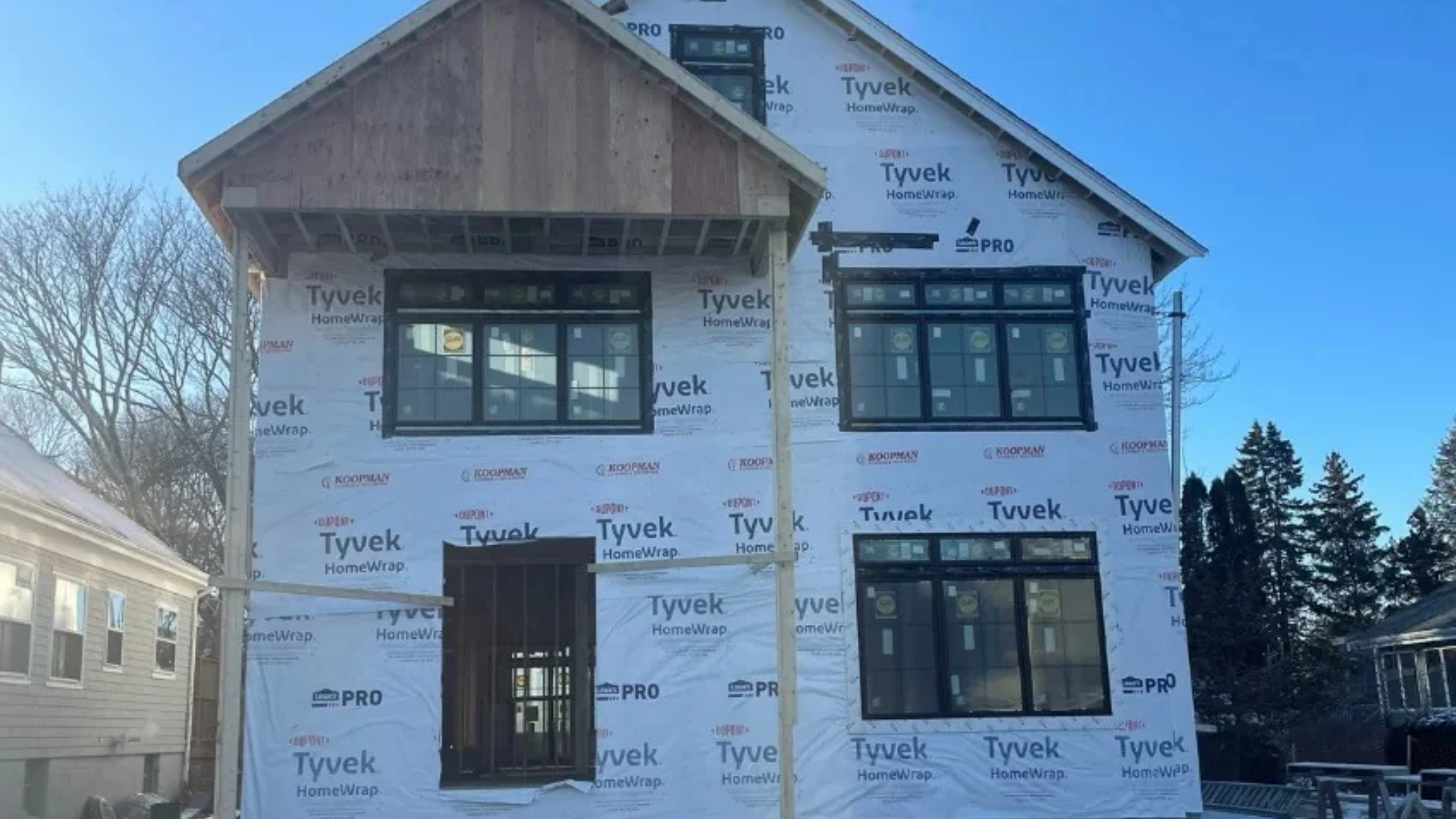

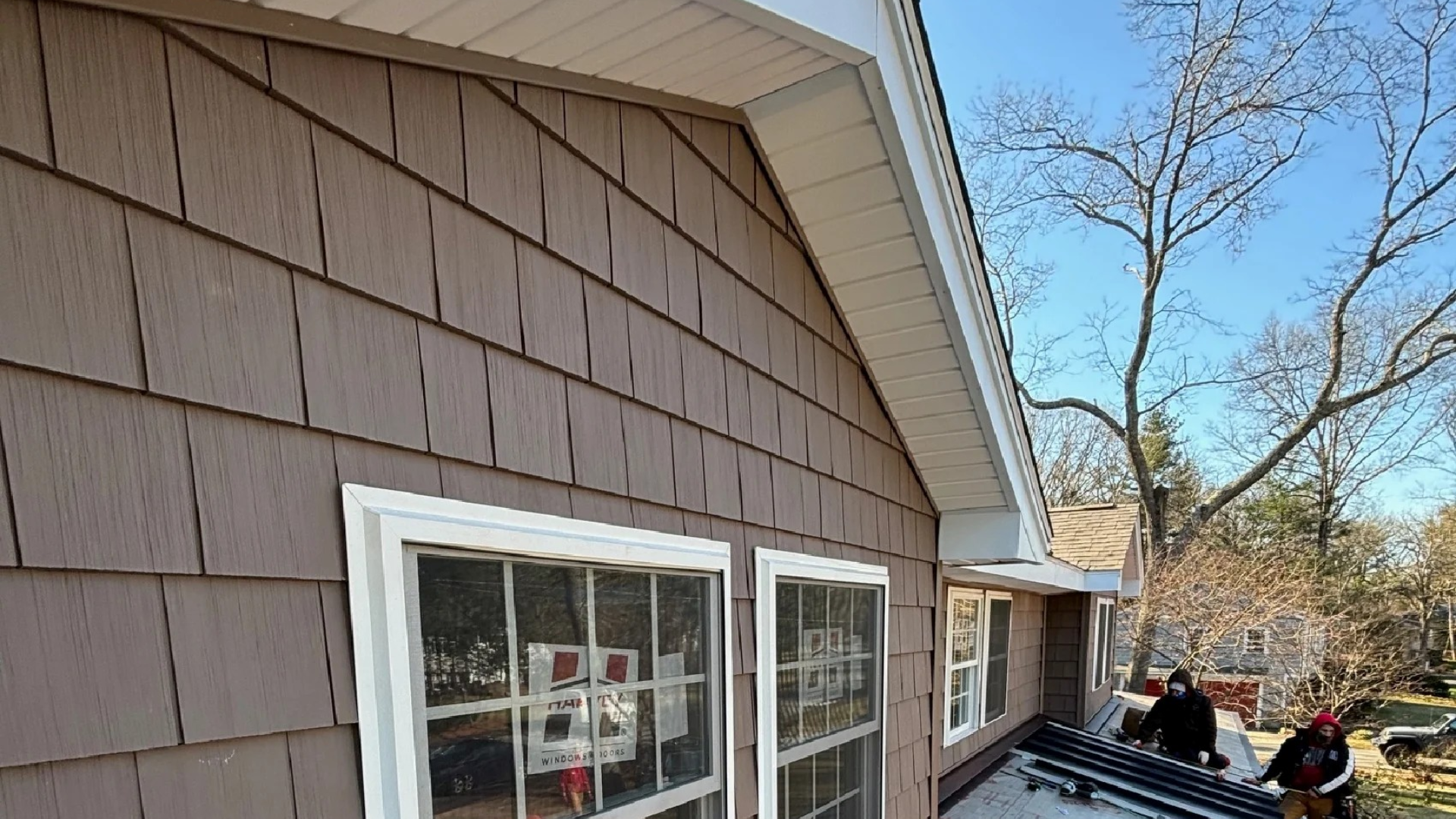
Choosing between vinyl vs fiber cement siding in Massachusetts can make a significant difference in how your home withstands harsh winter conditions. Both materials offer unique benefits, but they differ in cold-weather durability, moisture resistance, maintenance requirements, and installation costs. Understanding these differences will help you choose the best siding for your home.
Here is what actually happens to each material through a New England winter, and how to decide between them.
What winter does to vinyl siding
Vinyl is PVC. Like most plastics, it becomes harder and more brittle as its temperature falls. On a January morning in Massachusetts, a vinyl panel that would shrug off a knock in July can crack from the same impact — a snow blower throwing ice, a ladder set down carelessly, sheet ice sliding off a roof onto the wall below.
The bigger issue is movement. Vinyl expands and contracts noticeably with temperature, and across a Massachusetts year it goes through a wide swing. That is why vinyl is designed to hang rather than be fixed tight: panels interlock and the nails sit loose in slotted holes so the material can slide.
Get that wrong and the wall tells on you within a couple of seasons. Nails driven home instead of left loose, panels snapped together under tension, no gap left at trim — and you get buckling in summer and cracked panels in winter. This is the single most common siding defect we see on older installations, and it is an installation fault, not a material fault.
Where vinyl does well: it never needs painting, it doesn’t rot, it doesn’t absorb water, it’s light, and it’s the most affordable option by a clear margin. Modern insulated vinyl is a genuine step up from the thin products that gave vinyl its reputation in the 1990s.
What winter does to fiber cement
Fiber cement is cement, sand and cellulose fibre. It is dimensionally stable — it barely moves with temperature — and it doesn’t become brittle in the cold. It’s also non-combustible, which vinyl is not.
Its weakness is water, not cold. If moisture gets into the board and then freezes, the freeze-thaw cycle is what damages it. In a climate like ours, that makes three things non-negotiable:
- Proper clearance at the ground — boards held off grade, decks and roofs, not sitting where snow piles against them all winter.
- Correct flashing and a drainage plane behind the siding, so water that gets past the surface can get back out.
- Cut edges sealed, because a raw cut edge is the easiest way in.
Manufacturers now sell climate-specific formulations — James Hardie’s HardieZone system puts Massachusetts in HZ5, the cold-and-wet zone, with boards they say are engineered for better moisture resistance and paint adhesion, plus a drip edge.
One honest caveat: those cold-climate claims come from the manufacturer’s own marketing, and they don’t publish freeze-thaw test data to back them up. The underlying logic is sound and the product is well regarded, but treat “engineered for your climate” as a reason to buy the right version — not as a guarantee.
The trade-off: fiber cement is heavier, slower and more skilled to install, and it is painted. Factory finishes last a long time, but at some point it needs repainting. Vinyl never does.
Vinyl vs Fiber Cement Siding in Massachusetts: Key Differences
| Vinyl | Fiber cement | |
| Cold-weather brittleness | Gets more brittle as temperature drops | Not affected |
| Seasonal movement | Significant — must be hung loose | Minimal |
| Impact from falling ice | More vulnerable in deep cold | Holds up well |
| Water and freeze-thaw | Doesn’t absorb water | Needs correct detailing or freeze-thaw damages it |
| Fire | Combustible | Non-combustible |
| Repainting | Never | Eventually |
| Installed cost | Lower — typically around half | Typically about double vinyl |
| Weight / install skill | Light, faster | Heavy, slower, more skill required |
Prices move constantly and vary by house, so treat the cost line as a ratio, not a number. Get local quotes for your own walls.
Vinyl vs Fiber Cement Siding in Massachusetts: Which Should You Choose?
Choose vinyl if you are working to a budget, you want zero repainting, and the house isn’t in a spot that takes a beating — no roofline dumping ice onto a wall, no snow drifting hard against the lower courses.
Choose fiber cement if you are staying in the house long term, you want the look of painted wood without the maintenance, you’re on an older home where appearance matters, or you have a wall that regularly takes ice and snow.
Either way, the detailing decides it. Flashing at windows and doors, the water-resistive barrier behind the siding, clearance at the ground, and the right fastening method. Those are what fail in a Massachusetts winter. The material choice is the smaller half of the decision.
Who this is for
- Homeowners in MetroWest and Worcester County weighing up a full re-side and trying to work out whether fiber cement justifies the extra cost.
- Owners of older homes where the existing siding is failing and the wall underneath needs looking at properly before anything goes back on.
- Anyone whose vinyl is buckling or cracking — that is usually how it was fitted, and worth diagnosing before you replace the whole wall.
- Buyers who have had siding flagged on an inspection report.
Less relevant if you’re after a small repair rather than a replacement, or if the house is new construction, where different rules apply.
What we provide
At Maximus Consult & Develop in Milford, MA, we install both, and we will tell you plainly which one your house actually needs.
- Full siding replacement in vinyl, insulated vinyl, fiber cement and cedar.
- Tear-off and wall inspection — we look at the sheathing and the water barrier before anything new goes up. On older homes this is where the real problems are.
- Correct flashing and drainage detailing at windows, doors, roof-wall junctions and at grade.
- Siding repair for storm damage, cracked panels and failed sections.
- Trim, soffit and fascia finished to match.
- Free written estimates with a full cost breakdown.
Why choose us
We’re a Milford-based builder working across Framingham, Natick, Hopkinton, Franklin, Medway, Holliston, Mendon and the surrounding towns. We see the same winter you do, on the same housing stock, and we know which walls in this area take the worst of it.
We hold current Construction Supervisor License and Home Improvement Contractor registration. You get a written contract with a cost breakdown and a schedule — Massachusetts requires that in writing on any home improvement job over $1,000, and caps your deposit at one third of the contract price. We work to both.
Before hiring anyone for siding work in Massachusetts — us included — check their HIC registration and complaint history on the MA Contractor Hub. It takes a minute and it is the single best protection you have.
Frequently asked questions
How long does each one last? Both are long-life materials when properly installed — decades rather than years. What shortens either is poor detailing, trapped moisture, or impact damage left unrepaired. Manufacturer warranties differ, so compare them on the specific products you’re quoted.
Does fiber cement crack in cold weather? Not from cold itself. The risk is water getting into the board and then freezing. That is why ground clearance, flashing and sealed cut edges matter so much here.
Will vinyl siding crack in a Massachusetts winter? It can, if something hits it while it is very cold — ice off a roof, a snow blower, a dropped ladder. It is also more likely to crack if it was nailed too tightly and cannot move.
Is fiber cement worth double the price? Depends how long you’re staying and what the wall goes through. On a long-term home with a wall that takes ice every winter, usually yes. On a straightforward house you plan to sell in a few years, vinyl is a sensible choice.
My vinyl siding is buckling. Does the whole wall need replacing? Often not. Buckling is usually a fastening problem rather than a material failure. Have it looked at before you commit to a full replacement.
Do I need a permit to re-side my house in Massachusetts? Many Massachusetts towns require one for siding replacement, and requirements vary by town. Check with your local building department — and have your registered contractor pull the permit, not you. Here’s why that matters.
Can you side over the existing siding? Sometimes, but we generally advise against it on older homes. Going over the top hides whatever is happening to the sheathing underneath, and in this climate that is exactly what you want to see.
Thinking about new siding?
We will come out, look at the walls properly, and give you a straight recommendation — including when the cheaper option is the right one.
Call (508) 377-2110 for a free estimate, or request one online.